Of all the chimney calls Chimney Moncton refers out, the leaning chimney is the one where a wrong diagnosis costs the most. Repoint a stack that's tipping on a settled footing and you've decorated a falling structure; rebuild a whole chimney whose only problem was six tipped courses at the top and you've spent triple. So this page does what the assessment does: separates the two failures.
Failure one: the tipped top
Stand back from the house and sight up the chimney. If the stack rises plumb from the ground and only the section above the roofline drifts off vertical, you're looking at the common Moncton case: the weather side of the exposed stack has lost its mortar. Wind-driven rain and freeze-thaw attack the windward joints hardest; as the bedding erodes, the courses settle unevenly toward the eaten side and the top begins to tip — usually toward the prevailing weather. You'll often see the confirming evidence around it: spalled brick faces, mortar sand on the shingles, a cracked or absent crown that let the process start.
The fix is the standard partial rebuild from the roofline up — typically $2,000–$5,000: dismantle the tipped section down to sound, level bedding, relay it plumb with matched brick, cast a proper crown, cap it. The tilt disappears because the masonry causing it is gone, not persuaded back into line.
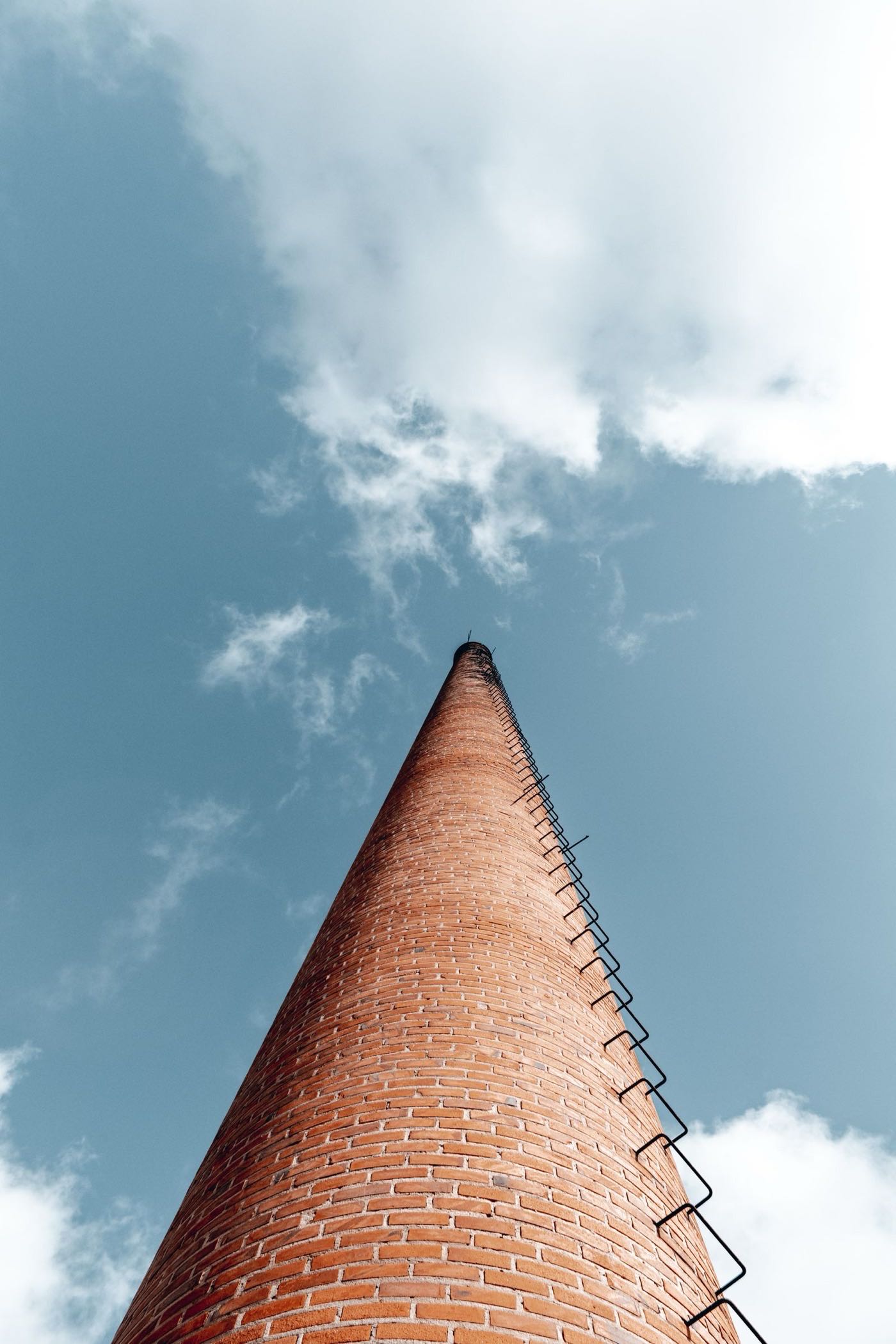
Failure two: the tilting stack
If the lean runs from the ground up — or the chimney is pulling away from the house wall, opening a gap you can see daylight through — the masonry isn't the cause. The footing is. A masonry chimney is enormously heavy for its footprint, and on many homes its footing is separate from the house foundation and shallower. When that footing settles — soft or wet ground (no rarity in the low-lying stretches near the Petitcodiac), an undersized original pour, or frost getting under a shallow base — the stack rotates as a unit. The house stays put; the chimney doesn't.
The telltales of a footing problem: a wedge-shaped gap between chimney and siding that widens with height, previous owners' caulk or spray-foam filling that gap (a repair that treats the symptom and hides the evidence), stair-step cracking where the chimney shoulder meets the wall, and a lean that measurably grows year over year.
Why lean is more than cosmetic
- Falling masonry. A tipped top sheds brick onto driveways, decks and heads. This is the failure mode with a physical hazard attached.
- A broken flue. The movement that tips a stack cracks and offsets the clay flue tiles inside it. A misaligned flue leaks heat and combustion gases — including carbon monoxide — into the chimney core and toward framing. If a wood or oil appliance vents through a newly leaning chimney, stop using it until it's assessed; the liner page covers what movement does to flues.
- The paper trail. A lean is visible from the street, which means every home inspector, every insurer's WETT inspector, and every buyer's agent will raise it. Unaddressed, it becomes a standing deduction on the house's value. Our WETT & insurance page covers how that file plays out.
Stabilize or rebuild — the actual decision
For the tipped top, there's no dilemma: rebuild the section. For the tilting stack, two honest paths exist, and the right one is economic as much as structural:
Stabilize: underpin the footing — helical piers or equivalent, installed by a foundation contractor — to stop the movement, then repair the masonry consequences (repoint the stressed joints, reline if tiles cracked, close and flash the separation gap). This route makes sense for large, multi-flue stacks in otherwise good condition, where the masonry is worth preserving and dismantling it would cost more than the piers.
Rebuild: dismantle the stack and rebuild it plumb on a corrected footing — full-rebuild territory, $3,000–$10,000+. For modest single-flue chimneys, this is frequently the cheaper and cleaner answer: the new stack is sound from footing to crown, lined and documented, with nothing inherited from the failure.
What you should be skeptical of is anything that promises to fix a ground-up lean from the top: repointing over a moving base, straps and brackets as a permanent answer, or foam in the gap. Movement stops at the footing or it doesn't stop. Pricing context for every path is on the cost page.
Not sure which failure you have? That's normal — the wedge-gap and the weathered-top cases can coexist on the same chimney. The assessment settles it: sight-lines, gap measurement, a look at the base and the attic penetration. Then the quote matches the actual problem, which is the entire point.